CE marking for aggregates from gabions: obligations and requirements according to UNI EN 13383-1
12 May 2025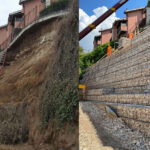
The winning solution: implementation of the Colleferro gabion wall
16 June 2025
When nature puts engineering to the test:
analysis of a consolidation intervention in Colleferro
Part one: from disruption to design solutions
The landslide phenomenon: when the balance breaks down
The hydrogeological instability represents one of the most complex challenges forcivil engineering Italian. Between February and March, when rainfall often reaches seasonal peaks, the country is frequently faced with events that put infrastructure and public safety at risk.
The case of Colleferro, in the province of Rome, represents a prime example of how intense weather events can trigger slope instability phenomena with immediate consequences for urban safety. L' intervention carried out to secure the instability led to the construction of what is now recognized as one of the highest gabion retaining walls in Europe, testifying to Italian technical excellence in slope consolidation.
The analysis of this case study, told through the words of Eng.Ing. Alessandra Spelta, who oversaw the project with the technical assistance of Metallurgica Ledrense, allows us to understand how the methodological approach in the evaluation of design solutions is decisive for the success of complex geotechnical engineering interventions.
The event on February 3, 2019
The work described below stems from the need to secure the slope of an escarpment that in the late afternoon of February 3, 2019, due to the copious rainfall in the period preceding the event, was affected by a landslide that involved a front of about 30 ml in length for a height of about 12 mt..
The landslide phenomenon involved, downstream a yard for parking municipal vehicles and, upstream a pedestrian path serving three apartment buildings for civilian housing.
The methodological approach
I inspections carried out at the site, the specific indications provided by the geologist, and theanalysis of the local geological, geomorphological and hydrogeological situation, aimed in particular at defining the possible evolution of the instability, have allowed, preliminarily, to study various technical solutions to solve the problem and, the final intervention proposal, resulted from thecomparative examination, in all their static and functional aspects of the various solutions studied in the preliminary phase.
First design hypothesis
The first hypothesis, which envisaged the construction of a reinforced concrete retaining wall in the lower part of the escarpment of a height equal to about 5.50 m and a drainage system on the back of the wall with arid material of suitable size and well compacted so as to constitute support base for the foundation of the upper wall in metal gabions of a height equal to about 6 m, later discarded due to the actual difficulties associated with the construction of the gabion support surface.
Second design hypothesis
The second hypothesis, which envisaged the construction of a reinforced concrete retaining wall in the lower part of the slope with a height of about 5.50 m as in hypothesis 1 and a drainage system on the back of the wall with arid material of suitable size well compacted so as to form a support base for the foundation of the upper wall also made of reinforced concrete with a height of about 6 m, on the back of which a Drainage system similarly to the lower wall, was not chosen because additional risky excavation of the slope would have been necessary to allow the upper portion of the wall to be housed.

Third design hypothesis
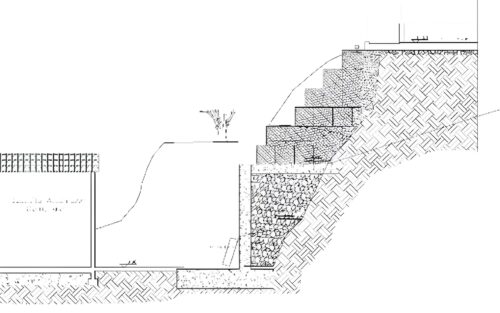
The third hypothesis, which was also the most viable to ensure the effective safety of the slope over time, involved the construction of a wall of pre-filled load-bearing metal gabions for a height of 11.50 m, resting on a concrete foundation and backfill, after laying nonwoven geotextile, in inert material; at the base of the wall, a drainage system was made by laying a polyethylene pipe, corrugated double-walled, with transverse cracks and covered with geotextile; in addition, the channeling of water from the grids of the footpath located upstream of the slope was made.

Toward the final choice
The comparative analysis of the three design hypotheses shows that the design of consolidation interventions requires a multidisciplinary assessment that takes into account not only structural aspects, but also the executive feasibility and the sustainability of the work over time.
The third solution, based entirely on metal gabions, proved to be a winner due to several factors that we will explore in more detail in the second part of this study: from the technical reasons behind its choice, to the operational steps that led to the realization of a'work of excellence recognized at the European level.
In the next article we will analyze the reasons that made metal gabions the optimal solution for this intervention and we will retrace the construction phases that allowed for the successful completion of one of the most challenging consolidation projects in recent years.


Eng. Alessandra Spelta
Discover what's new from Metallurgica Ledrense