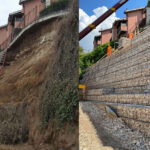
The winning solution: implementation of the Colleferro gabion wall
16 June 2025
Structural and architectural welded mesh gabions – Technical, architectural and green optics aspects
3 September 2025
CE Marking Electro Welded Mesh Gabions: Comprehensive Guide to Laboratory Testing and Mandatory Certifications
In the field of structural and geotechnical works, the choice of electrowelded mesh gabions with CE marking can be a useful system to ensure the safety and regulatory compliance of projects. With the entry into force of the DM 14.01.2008 (NTC 2008), building professionals - engineers, surveyors, architects and designers - must pay special attention to the qualification of innovative building materials intended for structural purposes.
CE marking for structural gabions is not just a bureaucratic requirement, but represents the guarantee that the product has passed specific laboratory tests and tests of strength mechanical strength, and that it is subject to daily inspections by the manufacturer and annual inspections by a Notified Body (TAB) according to the most stringent European standards. This certification process, based on the European Technical Assessment (ETA) and on document EAD 200020-00-0102, ensures that the gabions can withstand the stresses expected in consolidation works, retaining works and geotechnical solutions.
For professionals designing gabion works, understanding the technical parameters and strength tests required by regulations means being able to assess the reliability of suppliers e select them with confidence, while ensuring the durability of structures and compliance with the Technical Standards for Construction. The documents to control these products are the declaration of performance, CE marking, instructions and safety information.
In this article, engineer Simone Graffer will explore in detail all the technical and regulatory aspects of this complex certification process.
Regulatory Requirements and Obligations for CE Marking
Electrowelded mesh gabions filled with stone material are considered "innovative" construction products with a structural purpose. The obligations under Chapter 11 of the DM 17.01.2018 (Technical Standards for Construction - NTC). include the identification and qualification of materials and products according to specific procedures under the responsibility of the manufacturer who, in this case, must achieve the CE marking on the basis of the relevant "European Technical Assessment" (ETA) or must obtain a "Technical Assessment Certificate" issued by the president of the CSLP.
The laboratory tests required to obtain the CE marking of aluminum zinc-coated welded mesh gabions are listed in the EAD 200020-00-0102.
Mechanical Tests: Tensile Strength of Wires
Tensile Testing According to UNI EN 10218-1:2012
Firstly, the tensile mechanical test of the wires should be carried out, as stipulated in Section 2.2.2 of the EAD 200020-00-0102. The test methodology is described in the UNI EN 10218-1:2012 "Steel wire and its products - General - Part 1: Test methods" in Chapter 3 - "Tensile test"..
The following should be verified 4 wire samples of 300 mm in length.
Resistance Requirements according to UNI EN 10223-8:2014
Test results must comply with the requirements of the standard UNI EN 10223-8:2014 "Steel wire and drawn products for fencing and netting - Part 8: Electrowelded mesh gabions" in section 7.4 "Wire properties for electrowelded gabions and mattresses".
The minimum tensile strength must be greater than 500 MPa.
It is evident that this essential characteristic has an important influence relatively to all mechanical stresses that can strain the gabion, both in terms of deformability and breaking point.
Shear Strength Tests of Welds
Weld Strength Testing
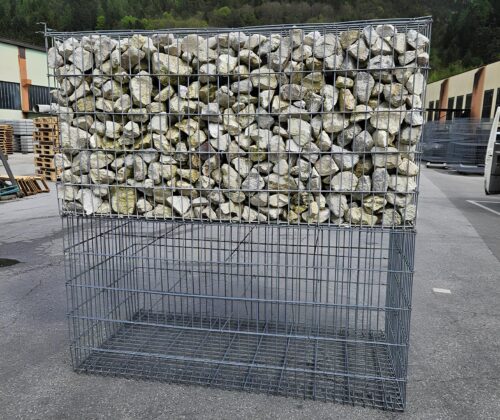
Then the mechanical test related to the shear strength of the weld should be carried out, which as pointed out by the standard UNI EN 10223-8:2014 paragraph 7.5 requires that. "The average shear strength of four randomly selected welds from a panel shall not be less than 75% of the breaking load of the wire (maximum force during the tensile test) with no single weld less than 50%."
This essential feature is crucial because the welds are stressed by external mechanical actions, and any failure of the welds can lead to destabilization of the entire artifact.

Durability Testing: Verification of Galvanizing
Zinc-Aluminum Thickness Measurement
We then move on to the part about verifying the durability of the product and then testing the galvanization.
The thickness of the zinc-aluminum following the indications of the standard UNI EN 10244-2:2023 "Steel wire and drawn products - Nonferrous metal coatings on steel wires - Part 2: Coatings of zinc or zinc alloys".
Measurement Methodology
The thickness of aluminum zinc should be measured using 5 pieces of wire, each 100 mm long. Each piece should be cleaned and then weighed. Next, the coating of the wire portions should be dissolved in an acidic HCl solution with a concentration of 1.19 g/ml with the addition of corrosion inhibitor (antimony chloride 3.2 g in 500 ml of concentrated acid solution) until the coating is completely dissolved, in accordance with Section 5.2.2.1 of the standard. The mass of the coating is obtained according to Section 5.2.2.2 of the standard.
The values of mass (g/m²) required to fall within Class A, the highest one, according to Table 2 of the standard EN 10244-2, are:
| Wire Diameter (mm) | Class A |
| 3.80-4.40 | 275 |
| 5.20-8.20 | 290 |
Classification by Environmental Aggressiveness
Use in Conditions of High Aggressiveness (C4)
The electrowelded mesh gabion protected by aluminum zinc alloy in class A can be used in conditions of "High aggressiveness (C4)" as stipulated in the standard UNI EN ISO 9223:2021 "Corrosion of metals and their alloys - Corrosivity of atmospheres - Classification, determination and evaluation", specifically:
"Water contact conditions. Temperate zone, atmospheric environment with high pollution or substantial effect of chlorides, e.g., polluted urban areas, industrial areas, coastal areas, no salt water spray, exposure to strong effect of deicing salts, e.g., subtropical and tropical zone, atmosphere with medium pollution, industrial areas, coastal areas, sheltered coastal locations. "
Evidence of Adherence of Galvanizing
Winding test according to ISO 7802:2013
The standard UNI EN 10244-2:2023 also requires, in section 4.2.5, to carry out a verification of adherence of the galvanizing to the steel wire by means of winding test in accordance with ISO 7802:2013 "Metallic materials - Wire - Wrapping test". This evidence is not covered in the EAD 200020-00-0102, so if implemented it should not be included in the ETA.
Methodology of the Coiling Test
To do this test, 5 galvanized wires with a length of 335 mm are to be used and wound, by means of a lathe, on a mandrel having a diameter 4 times that of the wire. Following the action of the mandrel on the wire, in the manner prescribed by the standard ISO 7802:2013, specimens should be visually inspected to assess any coating detachment.
Corrosion Testing: Salt Spray Test
Neutral Salt Spray Test
Finally, the neutral salt spray test should be carried out in accordance with the standard EN ISO 9227:2024 "Corrosion tests in artificial atmospheres - Salt spray tests", as stipulated in section 2.2.9.2 of the EAD 200020-00-0102 and in paragraph 7.6.1 of the standard UNI EN 10223-8:2014.
Four electrowelded mesh specimens of size 300x300 mm should be used, which after 1000 hours of exposure should have less than 5% surface area affected by rust.

Importance of Durability Testing
Tests related to the durability of the aluminum zinc protective alloy must enable the required minimum life of the specific artifact to be ensured. In particular, the verification of adhesion according to the ISO 7802:2013 allows it to be demonstrated that the galvanizing does not fail as a result of filling the gabion with stone material.
Conclusion
The laboratory tests for the CE marking of electrowelded mesh gabions represent an indispensable element to ensure the structural safety and the durability of artifacts made from these products. As highlighted by engineer Graffer's technical analysis, the certification process involves specific and rigorous tests ranging from the mechanical resistance of the wires at corrosion tests under highly aggressive environmental conditions.
The CE marking is not simply a regulatory requirement, but is a guarantee that the structural gabions have passed all the checks required by the EAD 200020-00-0102 and by the relevant technical standards. This aspect is particularly important when designing consolidation works, geotechnical interventions o containment solutions in environments characterized by high chemical aggressiveness.
Professionals in the construction industry need to take utmost care in the selecting suppliers who can guarantee full compliance with the Technical Standards for Construction (NTC 2018). Rely on manufacturers without CE marking exposes projects to serious structural risks and legal liabilities.
Metallurgical Ledrense, through its involvement in the production of gabions marked CE, offers designers the safety of materials tested to the highest regulatory standards, ensuring reliable performance even in the most severe environmental conditions and contributing to the construction of geotechnical works safe and durable over time.

Eng. Simone Graffer
Structural designer and safety expert, Eng. Simone Graffer is a technical consultant for CE certification of construction products and PPE. He has gained solid experience in European Technical Assessment (ETA) of innovative building systems. He has provided training for professional bodies throughout Italy and collaborates with entities such as the University of Trento and CNR. His experience ranges from design to quality control to construction management.
Discover what's new from Metallurgica Ledrense