


CLIENT: Soprintendenza Archeologia, Belle Arti e Paesaggio for the Metropolitan Area of Naples
LOCALITY: Cuma, Archaeological Area ex Fondo Artiaco (NA)
COMPLETION DATE: In progress
Artwork made with Ledrosteelbox gabions
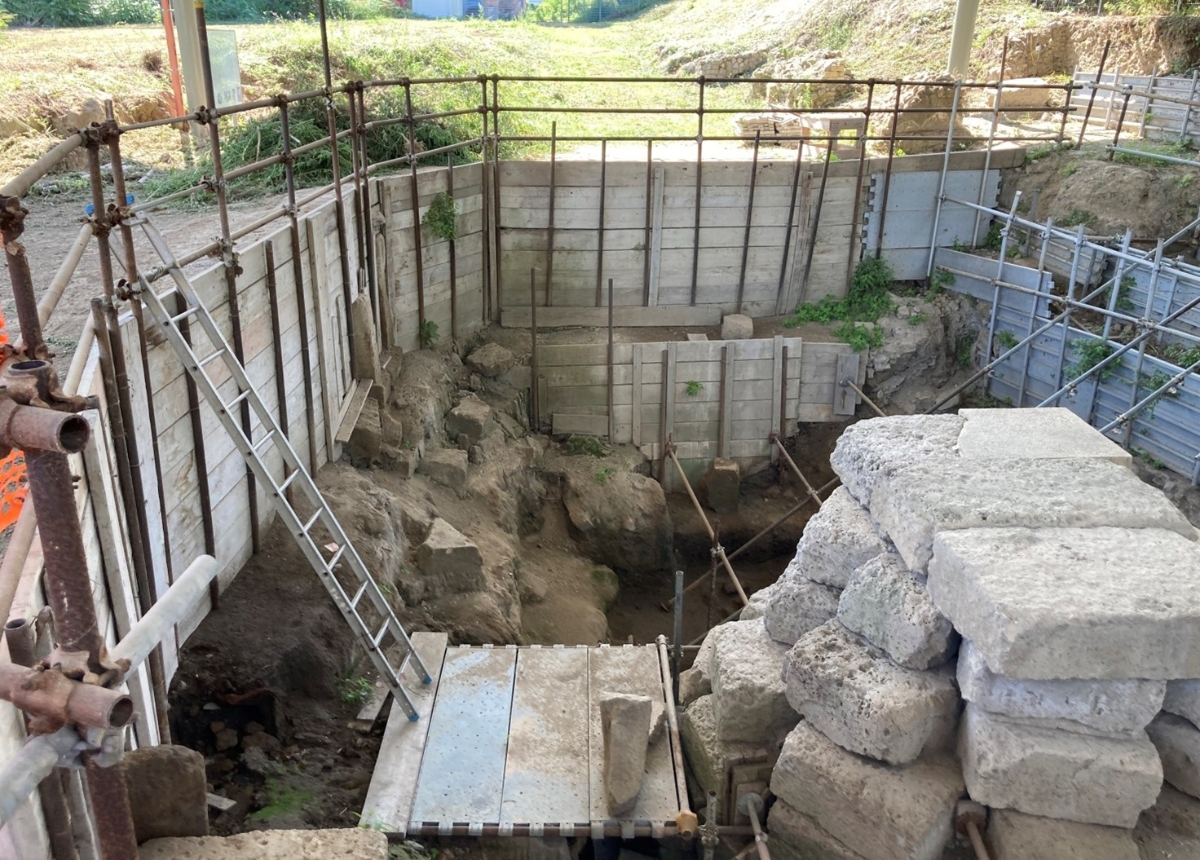
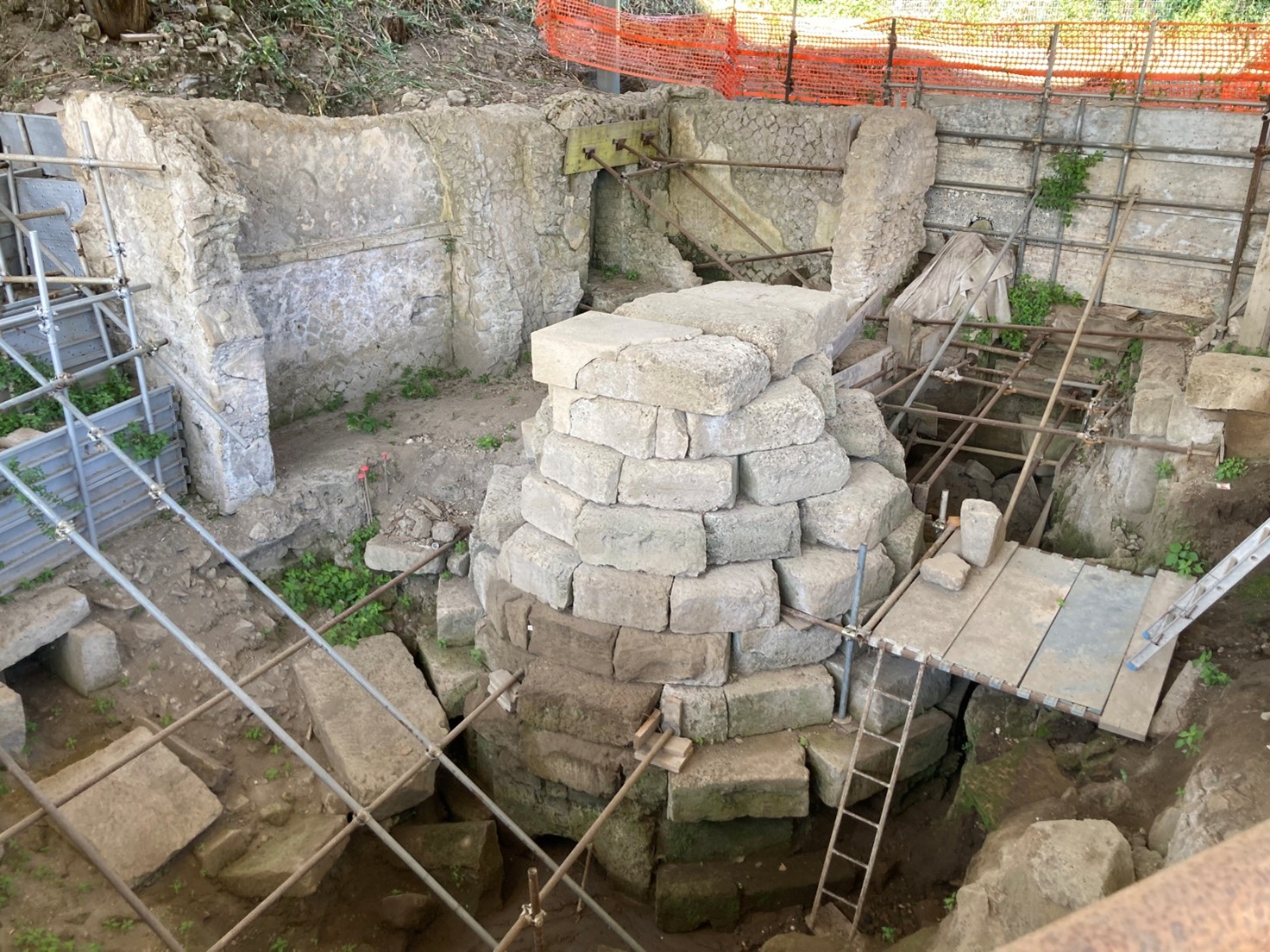
In the heart of the ancient city of Cuma, on the northern slope of the archaeological area former Artiaco Fund, stands an extraordinary example of funerary architecture: the Tholos Tomb. This rare monument, datable to the late 3rd to early 2nd century BCE, testifies to a late phase of the Cumaean necropolis, when Samnite influence had by then supplanted Greek influence.
Discovered in 1902 by the archaeologist G. Pellegrini, the tomb is characterized by a circular plan and a conical vault made of thirteen rows of carefully stacked dry tuff blocks. The south-facing entrance leads into a burial chamber that retains part of the original plaster and traces of pictorial decoration. Inside, a circular platform and an articulated system of burial receptacles, including a large sarcophagus with an inscription in Oscan language attributing its use to the gens Heia, a prominent family in Hellenistic Cumae.
The Superintendence intervened to secure the monument, located about 4.50 meters below ground level, and to continue with research that has returned valuable data on the stratigraphy of the necropolis and its evolution in Roman times.
GOAL:
The project aimed at the consolidation of the excavation fronts carried out to unearth the archaeological artifact. The intervention had to meet essential requirements: ensuring the structural safety of the excavations, protect the monument and enable the continuation of research activities, while maintaining the recognizability of the contemporary intervention from the ancient and the reversibility of the construction system.
At the design stage, public access to the Tomb was excluded, prioritizing the preservation of the monument and the needs of ongoing archaeological activities.
PROPOSAL:
To meet the design requirements and comply with the principles of archaeological restoration, the technology was adopted Ledrosteelbox: electrowelded mesh gabions used for support, containment and boundary works in a recognizable, reversible and protective manner.
This technique, already successfully used in numerous European interventions by renowned architects and researchers such as Toni Girones, Pedro Alarcao, and Dario Alvarez Alvarez, is particularly suitable for archaeological contexts due to its dynamic nature and the ability to dialogue with ancient structures without compromising their authenticity..
To make the effect of the final structure less impactful, the design included:
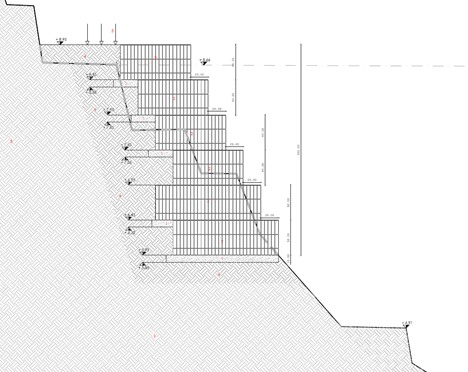
- Gabions with a height of 50 cm
- Setback of 25 cm at each floor
- Creation of a stepped wall that follows the morphology of the excavation
- Special attention to the choice of stone fill material, which is crucial for integration with the archaeological context
REALIZATION:
The design was coordinated with close cooperation between Metallurgica Ledrense and the planners responsible for the recovery, restoration and enhancement of the Archaeological Area. The elasticity and willingness to solve specific problems will allow, if necessary, to make gabions with special shapes adapted to the needs of the archaeological site.
The stepped system with progressive setback made it possible to:
- Ensure the stability structural stability of the excavation fronts
- Reduce the impact visually of the containment structure
- Maintain the reversibility of the intervention
- Facilitate any future modifications or expansionsi of the archaeological excavation
L'technical assistance specialized of Metallurgica Ledrense during the design and installation phase, will guarantee customized solutions for this unique and particularly challenging construction site.


OUR CONTRIBUTION
Ledrosteelbox technology represents the ideal solution for an intervention in an archaeological context of exceptional historical value. Metallurgica Ledrense stands out not only for the quality of the product, but also for the technical assistance, the support in the design phase, if necessary of implementation and for the ability to adapt to requests for customization of gabions with special shapes.
This operational flexibility is proving to be a key feature to be able to intervene in unique sites such as the Tomb at Tholos in Cuma, where the preservation of the archaeological heritage and the structural safety requirements must integrate with the utmost respect for the ancient material.
An intervention that confirms the versatility of Ledrosteelbox gabions even in delicate areas such as archaeological restoration, where recognizability, reversibility and compatibility with the pre-existence are fundamental principles to be respected.